Date: 06/22/2024 06/23/2024
Location: Star River Meditation Center
Teacher: Yunquan Huang
Dharma Knowledge
The Spread of Buddhism in India
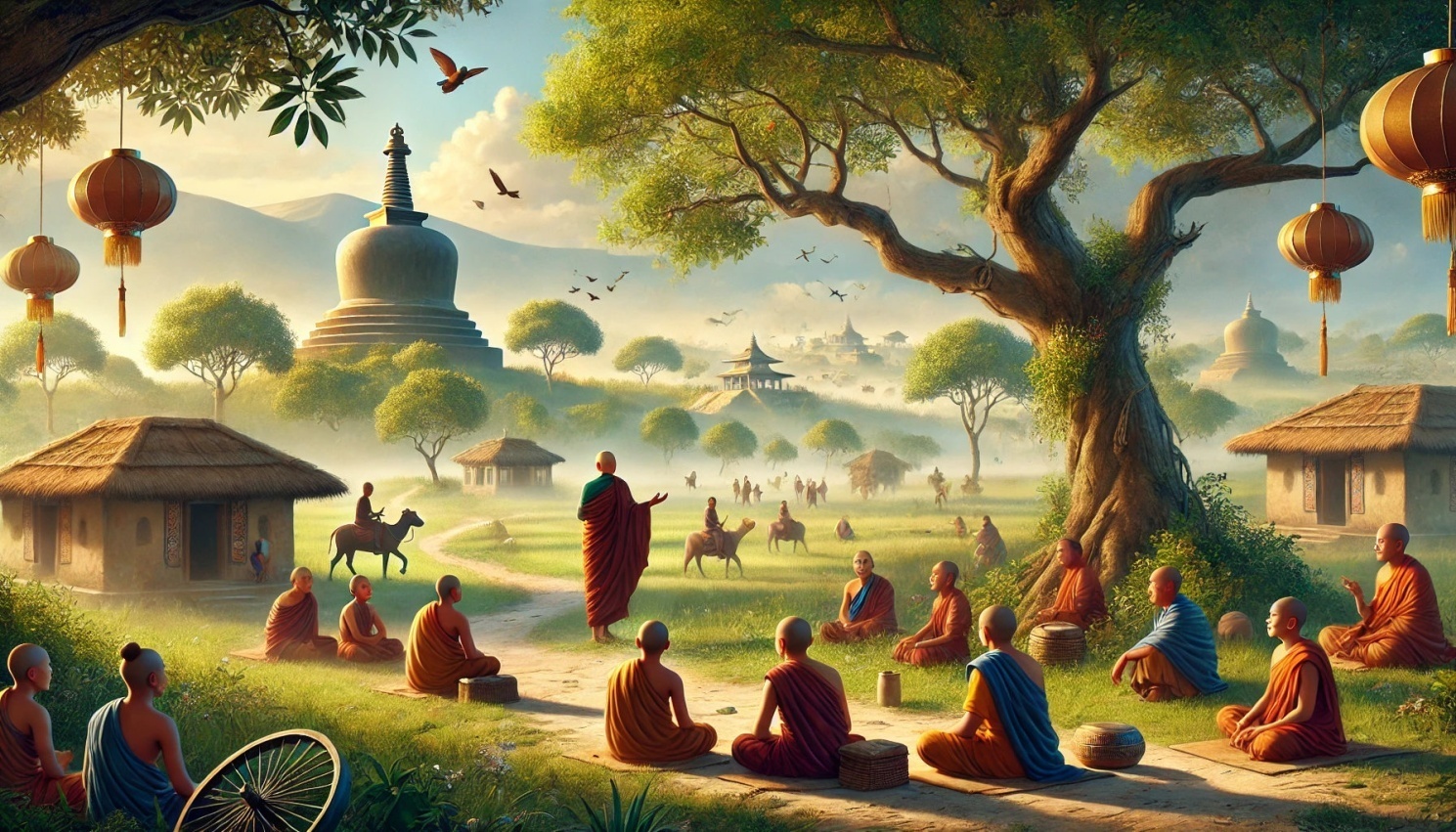
The spread of Buddhism in India began in the 6th century BCE, following the enlightenment and teachings of Siddhartha Gautama, known as the Buddha. After attaining awakening under the Bodhi tree, the Buddha spent the remainder of his life wandering through northern India, sharing the Dharma—the Four Noble Truths and the Eightfold Path—with people of all backgrounds. His teachings attracted a diverse group of followers, leading to the formation of monastic communities that became the foundation of Buddhist transmission.
After the Buddha’s passing (Parinirvana), his disciples convened councils to preserve and systematize his teachings. These early councils marked the beginning of a dynamic oral tradition, which eventually gave rise to various schools such as the Theravāda and Mahāsāṃghika. Despite doctrinal differences, these schools shared a common emphasis on ethics, meditation, and liberation from suffering. Buddhist monks traveled across the Indian subcontinent, spreading the teachings through public discourses, debates, and the example of monastic life.
A pivotal moment in the expansion of Buddhism came during the reign of Emperor Ashoka in the 3rd century BCE. After witnessing the devastation caused by his conquest of Kalinga, Ashoka converted to Buddhism and adopted it as a guiding principle for governance. He supported the construction of stupas and monasteries, inscribed edicts on pillars and rocks to promote ethical conduct, and dispatched missionary emissaries to various regions, including Sri Lanka, Central Asia, and Southeast Asia. Under Ashoka, Buddhism transformed from a regional tradition into a widespread transnational movement.
The transmission of Buddhism was further enabled by linguistic adaptation. Teachings originally conveyed in vernacular dialects such as Magadhi were later translated into Pāli and Sanskrit, making them accessible to wider audiences. Monasteries became not only centers of spiritual practice but also hubs of education, healthcare, and cultural exchange. Prestigious institutions like Nālandā and Vikramaśīla attracted scholars from across Asia, fostering a rich tradition of philosophical debate and scholarly production.
As the teachings evolved, new doctrinal developments emerged to meet the spiritual needs of broader society. Mahāyāna Buddhism introduced the ideal of the bodhisattva and emphasized compassion, universal salvation, and expansive cosmological visions. These teachings resonated with laypeople, royalty, merchants, and artisans alike, leading to the incorporation of Buddhist ideas into literature, sculpture, and monumental architecture. Sites such as the Ajanta Caves and Borobudur reflect the deep integration of Buddhism into cultural life.
However, from the 7th century onward, Buddhism in India began to decline. Internal factors such as doctrinal complexity and monastic laxity weakened its social support. The resurgence of Brahmanical traditions, which gradually absorbed or challenged Buddhist practices, further diminished its influence. Additionally, the arrival of Islamic invasions led to the destruction of many monasteries and educational centers. By the 13th century, Buddhism had nearly disappeared from its land of origin, surviving only in isolated regions.
Despite its decline in India, Buddhism’s legacy endured. Its philosophies, artistic expressions, and ethical principles had already taken root in other parts of Asia, where they continued to flourish. Today, Buddhism remains a global tradition, with millions of followers drawing inspiration from teachings that were first shared in the forests and villages of ancient India.
Thus, the spread of Buddhism in India was a profound historical journey shaped by spiritual insight, royal patronage, institutional development, and intercultural dialogue. Although its physical presence in India diminished, the Dharma it carried has traversed time and space, illuminating countless lives with the light of wisdom and compassion.