Date: 06/01/2024 06/02/2024
Location: Star River Meditation Center
Teacher: Yunquan Huang
Dharma Knowledge
The Buddha’s Nirvana
The Buddha’s nirvana was not the end of existence, nor a mysterious disappearance into the unknown. In the Buddhist understanding, nirvana does not mean death; it refers to the complete extinguishing of greed, hatred, and delusion—the fires that sustain suffering and rebirth. The Buddha’s passing into parinirvana marked the full completion of his awakening and his mission, a final demonstration of freedom beyond the cycle of life and death.
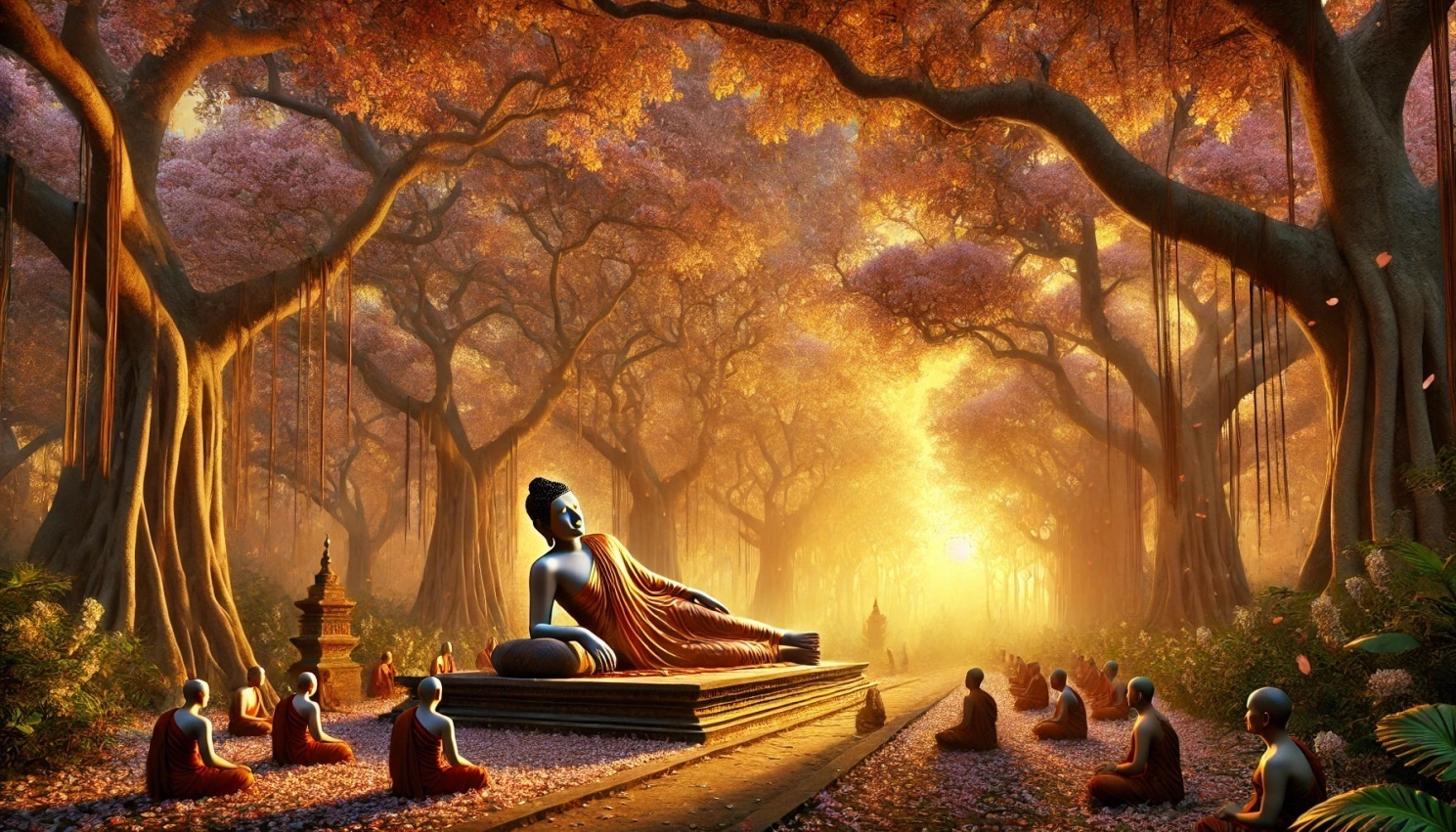
At the age of eighty, the Buddha arrived at Kushinagara and lay down between two sal trees. Though his body was afflicted by illness, his mind remained clear, steady, and fully aware. He did not evade aging or sickness through supernatural powers, nor did he dramatize his final moments. Instead, he faced death with mindfulness and equanimity, showing that even the dissolution of the body can be met with wisdom. His passing was not a defeat by mortality, but a calm release from all conditions.
Before entering nirvana, the Buddha repeatedly urged his disciples not to cling to his physical presence. He made it clear that the true refuge was not a person, but the Dharma and the discipline. “Take the Dharma as your teacher,” he advised. With these words, he redirected attention away from personal attachment and toward inner responsibility. His nirvana was not meant to leave a void, but to encourage maturity, independence, and confidence in the path.
The Buddha’s final teaching—“All conditioned things are impermanent. Strive with diligence”—summarized the essence of his entire life. It was not a lament, but a clear reminder. Because all things arise and pass away, practice matters. Because life is fragile and uncertain, awakening cannot be postponed. In this sense, the Buddha’s nirvana was his last and most powerful lesson: impermanence is not a reason for despair, but the very basis for liberation.
On a deeper level, the Buddha’s nirvana does not imply that the Buddha “no longer exists” in any ordinary sense. From the standpoint of the Dharma, the Buddha was never defined by a physical form alone. The Buddha is awakening itself—the realization of truth. Whenever ignorance is dispelled, whenever compassion and clarity arise, the Buddha is present in the Dharma. Nirvana, therefore, is not disappearance, but the complete merging of awakened wisdom with the timeless nature of reality.
After the Buddha’s passing, the Dharma did not fade. Guided by his teachings, the monastic community continued, the discourses were preserved, and the path of liberation spread far beyond its place of origin. This continuity was possible precisely because the Buddha did not base his teaching on personal authority or worship. Had his message depended on his presence, it would have vanished with him. Instead, his nirvana became the moment when responsibility passed fully into the hands of practitioners themselves.
Thus, the Buddha’s nirvana stands as a silent yet profound testament. It shows that true freedom does not depend on prolonging life, nor on clinging to form. A true teacher does not remain forever, but leaves behind a path. A true awakening does not end with death, but transcends it entirely. Through his nirvana, the Buddha affirmed what he had taught all along: liberation lies in letting go, awakening to impermanence, and realizing peace beyond all conditions.