时间:06/01/2024 06/02/2024
地点:星河禅修中心
主讲:黄云全
佛法知识
佛陀的涅槃
佛陀的涅槃,并非生命的终结,也不是某种神秘消失的传说,而是觉悟者圆满完成使命之后,对生死束缚的彻底超越。在佛法中,“涅槃”并不等同于死亡,它指的是贪、嗔、痴等烦恼之火的彻底熄灭,是对生死轮回根本因缘的止息。佛陀的入涅槃,既是一位觉者身相的谢幕,也是智慧与慈悲在世间完成示现的最后一课。
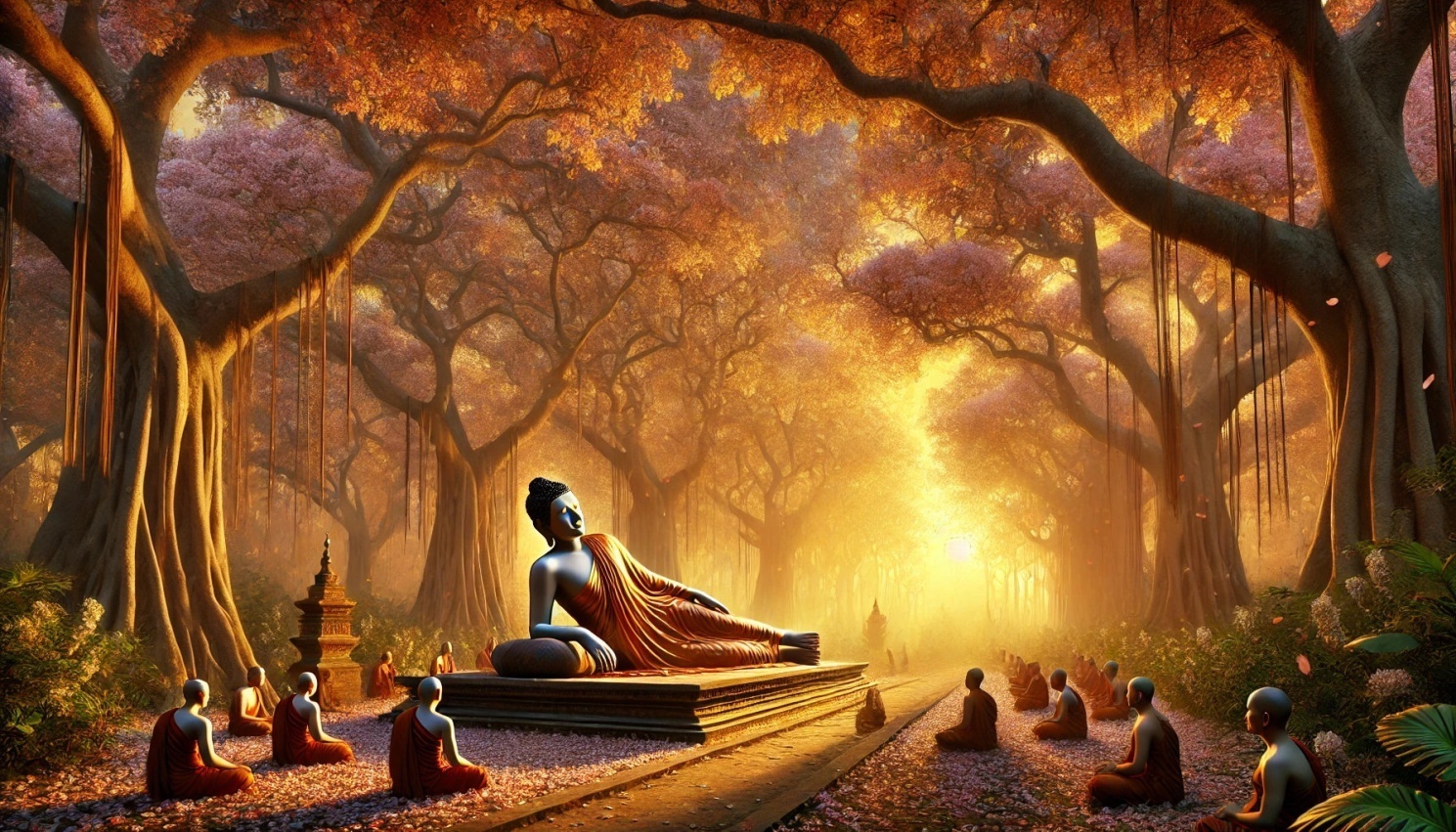
佛陀在八十岁时,行脚至拘尸那罗,卧于娑罗双树之间,身有病苦却心不动摇。他并未以神通回避老病,也未以威德掩盖无常,而是以最真实、最平凡的方式示现生命的终点。他安住正念,清楚觉知身心的变化,以从容、清醒的姿态走向般涅槃。这种示现,正是他一生教法的体现:万法无常,觉知不动;身会坏灭,智慧不灭。
在入涅槃之前,佛陀反复叮嘱弟子,不要因他的离去而悲伤或迷失方向。他明确指出,真正的依止并不在于个人的存在,而在于法与戒。他说:“以法为师,以戒为师。”这句话,揭示了佛陀对弟子最深的期望——不依赖权威、不执著形象,而是将觉悟之道内化为自身的修行与生命方向。佛陀的涅槃,并非留下空缺,而是促使弟子真正站立起来,依正法而行。
佛陀的最后教诲,浓缩了一生的修行要义:“诸行无常,勤修精进。”这既不是临终感慨,也不是抽象哲理,而是对生命真相的直接指引。正因为一切因缘法皆无常,修行才有意义;正因为时间有限、生命脆弱,觉醒才不可拖延。佛陀以自己的涅槃,提醒众生不要沉迷于永恒的幻觉,而要在当下的觉知中解脱。
从更深的层面看,佛陀的涅槃并不意味着“佛不在了”。在佛法的视角中,佛陀并非一个可被生灭定义的实体,而是觉悟本身的示现。当烦恼止息、智慧现前时,佛陀便在法中;当正念现前、慈悲运行时,佛陀便在当下。正因如此,佛陀的涅槃不是消失,而是从有限的身相,回归到无相的法性之中。
佛陀涅槃之后,佛法并未中断,反而因弟子们依教奉行而广泛流传。僧团得以继续运作,教法得以系统整理,佛陀所开示的解脱之道,被一代代实践、验证、传承。若佛陀以个人崇拜为核心,他的离去必然导致崩塌;正因为他始终强调觉知与实践,涅槃反而成为佛法成熟与独立的起点。
因此,佛陀的涅槃,是一堂无声却深刻的终极教育。它告诉人们:真正的觉悟,不依附于形式;真正的导师,不需要永远在场;真正的解脱,不受生死限制。佛陀以涅槃圆证一生的教导,使众生明白,唯有在无常中觉醒,在放下中自由,在实践中证悟,觉悟之光才会长明不灭。这正是释迦牟尼留给世界最深远的遗产。
Date: 06/01/2024 06/02/2024
Location: Star River Meditation Center
Teacher: Yunquan Huang
Dharma Knowledge
The Buddha’s Nirvana
The Buddha’s nirvana was not the end of existence, nor a mysterious disappearance into the unknown. In the Buddhist understanding, nirvana does not mean death; it refers to the complete extinguishing of greed, hatred, and delusion—the fires that sustain suffering and rebirth. The Buddha’s passing into parinirvana marked the full completion of his awakening and his mission, a final demonstration of freedom beyond the cycle of life and death.
At the age of eighty, the Buddha arrived at Kushinagara and lay down between two sal trees. Though his body was afflicted by illness, his mind remained clear, steady, and fully aware. He did not evade aging or sickness through supernatural powers, nor did he dramatize his final moments. Instead, he faced death with mindfulness and equanimity, showing that even the dissolution of the body can be met with wisdom. His passing was not a defeat by mortality, but a calm release from all conditions.
Before entering nirvana, the Buddha repeatedly urged his disciples not to cling to his physical presence. He made it clear that the true refuge was not a person, but the Dharma and the discipline. “Take the Dharma as your teacher,” he advised. With these words, he redirected attention away from personal attachment and toward inner responsibility. His nirvana was not meant to leave a void, but to encourage maturity, independence, and confidence in the path.
The Buddha’s final teaching—“All conditioned things are impermanent. Strive with diligence”—summarized the essence of his entire life. It was not a lament, but a clear reminder. Because all things arise and pass away, practice matters. Because life is fragile and uncertain, awakening cannot be postponed. In this sense, the Buddha’s nirvana was his last and most powerful lesson: impermanence is not a reason for despair, but the very basis for liberation.
On a deeper level, the Buddha’s nirvana does not imply that the Buddha “no longer exists” in any ordinary sense. From the standpoint of the Dharma, the Buddha was never defined by a physical form alone. The Buddha is awakening itself—the realization of truth. Whenever ignorance is dispelled, whenever compassion and clarity arise, the Buddha is present in the Dharma. Nirvana, therefore, is not disappearance, but the complete merging of awakened wisdom with the timeless nature of reality.
After the Buddha’s passing, the Dharma did not fade. Guided by his teachings, the monastic community continued, the discourses were preserved, and the path of liberation spread far beyond its place of origin. This continuity was possible precisely because the Buddha did not base his teaching on personal authority or worship. Had his message depended on his presence, it would have vanished with him. Instead, his nirvana became the moment when responsibility passed fully into the hands of practitioners themselves.
Thus, the Buddha’s nirvana stands as a silent yet profound testament. It shows that true freedom does not depend on prolonging life, nor on clinging to form. A true teacher does not remain forever, but leaves behind a path. A true awakening does not end with death, but transcends it entirely. Through his nirvana, the Buddha affirmed what he had taught all along: liberation lies in letting go, awakening to impermanence, and realizing peace beyond all conditions.