Date: 04/06/2024 04/07/2024
Location: Star River Meditation Center
Teacher: Yunquan Huang
Dharma Knowledge
The Awakening Under the Bodhi Tree
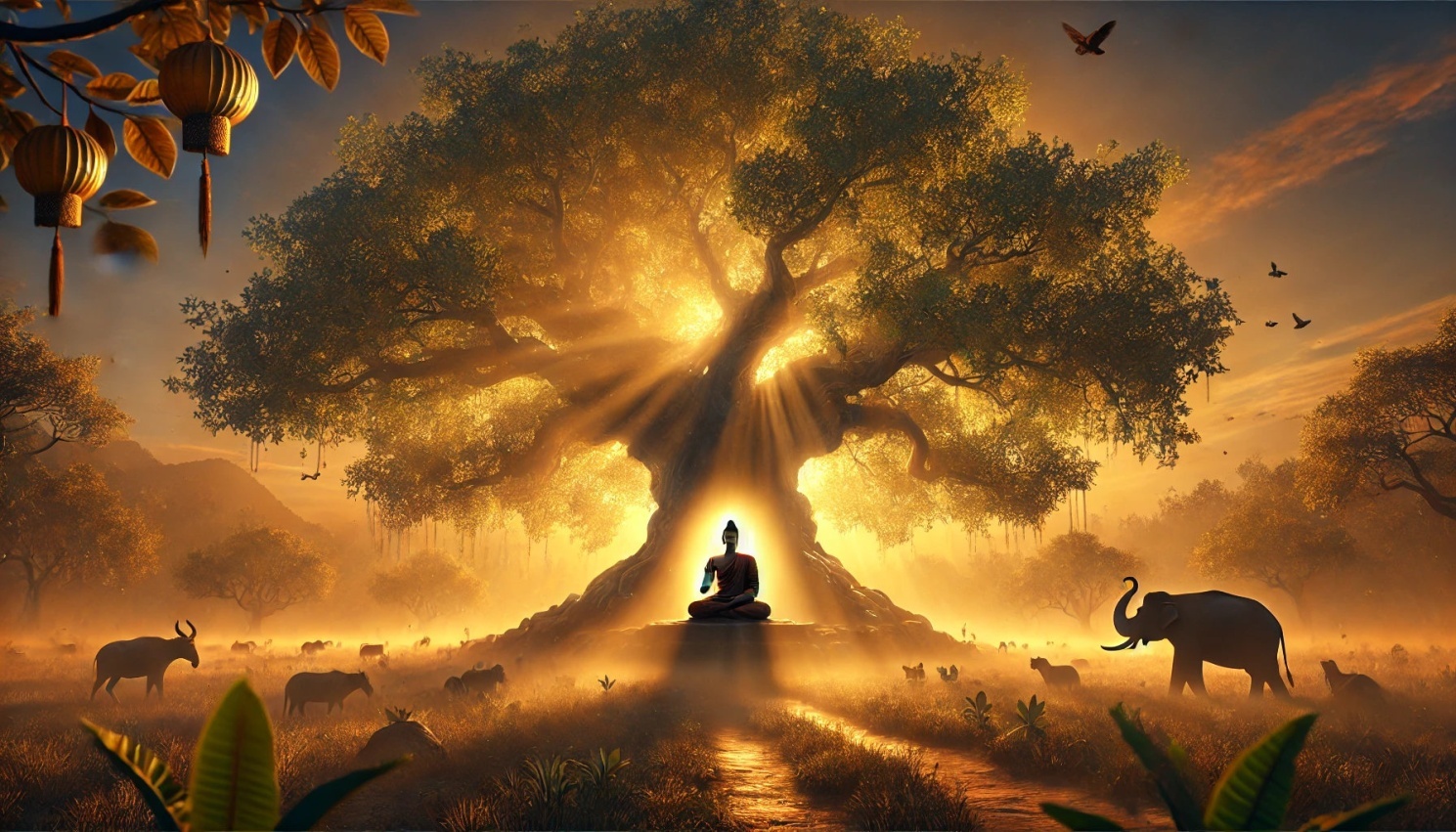
Beneath the Bodhi Tree by the Nerañjarā River in ancient India, Prince Siddhartha sat in deep meditation for seven days and nights. At dawn on the final day, as the morning star appeared in the sky, he pierced through the veils of ignorance and awakened fully to the truth of existence. This moment not only transformed his own life but illuminated a path of liberation for countless beings. From that moment forward, he became known as the Buddha—the Awakened One. And “the awakening under the Bodhi Tree” became a timeless symbol of human potential for clarity, compassion, and freedom.
This awakening was not a miracle in the traditional sense. It was not a gift from the divine, nor the product of rituals or belief. It was the natural result of sustained inquiry, sincere practice, and profound inner observation. The Buddha’s enlightenment was built upon years of exploration—first through luxury and pleasure, then through severe asceticism—before discovering the Middle Way, a path that avoids extremes and leads toward balance, insight, and peace.
Under the Bodhi Tree, Siddhartha entered deep meditative absorption. He began by recollecting countless past lives, seeing the endless cycle of birth and death. He then perceived the law of karma—how beings are shaped by their intentions and actions, and how suffering arises not from punishment but from the seeds we ourselves plant. Finally, in the deepest hour of the night, he realized the truth of dependent origination: that all phenomena arise in dependence on causes and conditions, that nothing exists independently, that all things are impermanent, unsatisfactory, and without a fixed self. This was not an intellectual insight, but a direct, experiential seeing that shattered all delusion.
The awakening under the Bodhi Tree was not about gaining something new, but about letting go of illusions—especially the illusion of a permanent “self.” The Buddha saw clearly that clinging to identity, resisting change, and misperceiving reality were the roots of suffering. When these distortions fell away, the mind was no longer bound. It became vast, tranquil, luminous, and unshakable. This state was not withdrawal from the world, but a deeper harmony with its true nature.
The Buddha’s awakening was not meant to be a personal achievement to be guarded or celebrated in isolation. From the moment of his enlightenment, he was moved by deep compassion to share what he had discovered. He saw that all beings possess the same potential for awakening, though obscured by ignorance. Out of this recognition, he taught the Dharma—not as dogma, but as a map to help others find their own way. His teachings on the Middle Way, the Four Noble Truths, and the Noble Eightfold Path are practical instructions born of this deep insight.
The awakening under the Bodhi Tree is not just a historical event—it is a mirror for all of us. It reminds us that clarity is possible, that freedom from suffering is attainable, not by clinging to beliefs or identities, but by seeing deeply into the nature of mind and experience. Whenever we pause, turn inward, and observe the arising and passing of thoughts without grasping, we begin to awaken. Whenever we release the compulsion to control, and instead meet life with curiosity and compassion, we draw closer to that same light.
Within each of us lies the seed of awakening, just as it did in Siddhartha. The Bodhi Tree, in this sense, is not merely a tree in India—it is a symbol of the still point within, where truth can be realized. When we sit with sincerity, when we look without distortion, when we open the heart without defense, then even in the midst of this noisy world, the Bodhi Tree blossoms again—and the light of awakening dawns.