Date: 03/23/2024 03/24/2024
Location: Star River Meditation Center
Teacher: Yunquan Huang
Dharma Knowledge
The Causes and Conditions of Prince Siddhartha’s Renunciation
Prince Siddhartha’s renunciation was neither an impulsive act nor an escape from worldly responsibility. It was the natural outcome of deep observation, sustained contemplation, and inner maturity. The causes and conditions that led him to leave home arose from his direct confrontation with the nature of life and his profound concern for the suffering of all beings. His decision represents a pivotal moment in human spiritual history—a turning away from the pursuit of external achievement toward the search for ultimate truth.
Born into royalty, Siddhartha enjoyed extraordinary privilege, comfort, and security. His father, wishing to shield him from the harsh realities of life, surrounded him with beauty and pleasure, hoping he would grow into a great king. Yet abundance did not bring lasting fulfillment. Even amidst luxury, Siddhartha sensed an unspoken unease—a realization that wealth and power could not protect anyone from aging, illness, or death. This quiet awareness marked the beginning of his inner awakening.
The decisive turning point came when Siddhartha encountered what are traditionally known as the four sights: an old person, a sick person, a corpse, and a wandering ascetic. Through these encounters, he saw clearly what had long been concealed from him—that all beings, regardless of status or fortune, are subject to decay and mortality. The sight of the ascetic, calm and dignified despite having renounced worldly life, suggested that there might be a path beyond suffering. These encounters shattered the illusion of permanence and forced Siddhartha to face the reality of impermanence head-on.
As he reflected deeply on what he had seen, Siddhartha understood that the problem was not individual misfortune but the very structure of conditioned existence. As long as one remains bound to birth and death, no pleasure can provide lasting satisfaction. This realization expanded his concern beyond personal destiny to encompass the fate of all beings. His central question became universal: Is there a way to transcend aging, sickness, and death altogether?
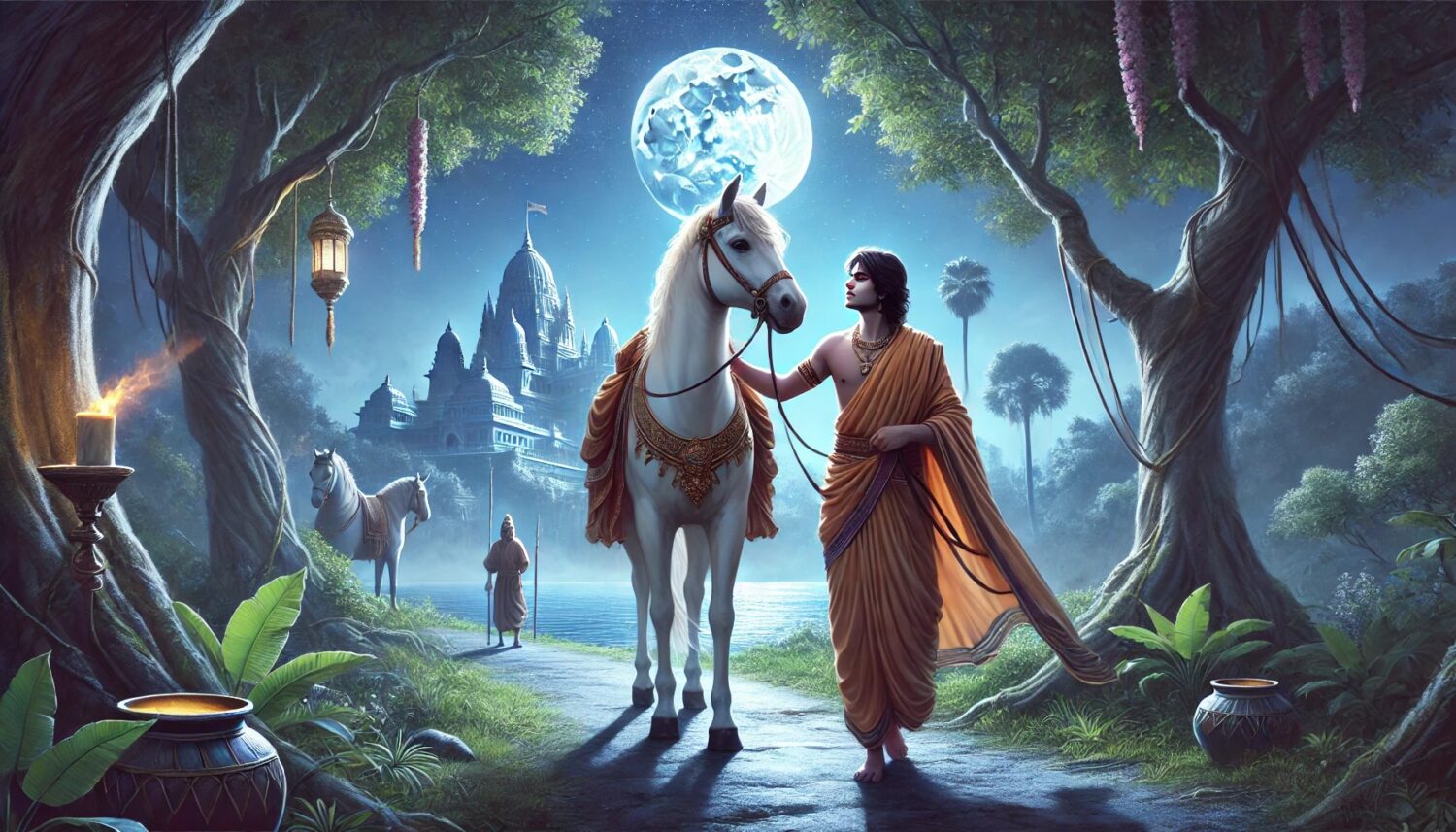
Seen in this light, Siddhartha’s renunciation was not a rejection of family, duty, or society, but an expression of deeper responsibility. He recognized that even the best governance could not solve the fundamental problem of suffering. If a path to liberation existed, discovering it would benefit not only himself but countless others. Guided by this aspiration, he quietly left the palace at night and embarked on the life of a seeker, determined to find the truth that leads to freedom.
It is significant that Siddhartha renounced the world not because of hardship, but despite having everything one could desire. His departure demonstrates that awakening is not born merely from suffering, but from insight into the nature of suffering. He saw that even the most ideal worldly conditions remain fragile and incomplete. This clarity gave his renunciation its profound depth and universal relevance.
On a deeper level, Siddhartha’s renunciation was the natural fruit of wisdom ripening within. When impermanence is no longer an abstract idea but a lived understanding, when compassion extends beyond personal boundaries, and when the longing for truth surpasses the need for comfort and convention, the impulse to renounce arises spontaneously. This renunciation is not abandonment, but reorientation—not escape, but a courageous movement toward reality.
Thus, the causes and conditions behind Prince Siddhartha’s renunciation are not merely an episode in Buddhist history, but a timeless illustration of human awakening. They remind us that when we truly see the limits of worldly satisfaction and sincerely seek what lies beyond, life itself begins to point toward deeper meaning. Renunciation, in this sense, is not simply leaving the world, but turning from ignorance to awareness, from narrow concerns to a boundless vision of liberation for all beings.