时间:05/30/2026 05/31/2026
地点:星河禅修中心
主讲:黄云全
佛法修行
至诚感应,信女得道
“摩诃罗者老年修,受供人愚说法愁;
自叹无知生苦恼,恭聆此语证初流。”
中印度摩竭陀国的首都王舍城外,有一座著名的佛寺——“松寺”,通常住有圣众百余位。
距离松寺不远的村庄中,有一位虔诚的优婆夷——在家学佛的女居士、信女。这位优婆夷非常的聪明,她认为:“佛经所说的教理,是修行学佛的途径,通达了佛理,才能够得到悟道成就。否则是盲修瞎练,反招恶果。”所以,她经常以竭诚恭敬的清净心,恳请法师开示佛法。
优婆夷每天供养一位比丘,由“松寺”的住持安排众僧应供的次序,依次前往优婆夷的家里去接受供养。每天在供僧之后,她总是至诚地恭请法师开示佛法,求问经义。僧团中有些对于闻、思、修三慧学习不甚深入的比丘,时常不敢轻率的前往受供。
摩诃罗比丘,是一位一无所知——新出家的老人,有一天,正好轮到他去应供。这位在晚年才出家的老比丘,时常听到寺中的僧众说:“这位优婆夷非常难得,她不但竭诚供养三宝,而且精通一般的佛经教理。”因之使他感到胆怯,不敢前往受供。可是,寺中常住的安排,又不得不去。老比丘怀着惴惴畏惧与忧恼的心情,徐缓的步行前去,内心则感到进退两难,结果到达优婆夷的家里,已经超过约束的时间了。
优婆夷看见这位老比丘,非常欢喜的说:“今天这位长老,年高德劭,行步详序,与众不同。”她暗自想道:“这位老比丘,一定是得到成就的圣者,他所说的话一定也是至为宝贵的妙法,我要特别慎重的聆听,不可失去这次求法的好机会。”于是她就特别的供养老比丘。
供养完毕之后,优婆夷随即敷设高座,恭请老比丘上座说法。优婆夷竭诚恭敬的在座前五体投地,叩头求法,不敢仰视。一无所知的摩诃罗,登座之后,既恐慌又惭愧,他眼见优婆夷非常恭敬的跪在法座之前,不禁低声自叹:“人愚无知,实在苦恼!”优婆夷听到这两句话,视为无上至宝,如入禅定似的。老比丘趁优婆夷一心专注的时候,快速地跑回松寺。
优婆夷慎重的善自思惟这两句话的奥妙之处:“愚无所知,就是十二因缘的根本,由此苦本,生死循环不断,以致受诸苦恼,故言甚苦。”如此反复思惟,立即证得四圣中的初果——须陀洹道——凡夫初入圣道之法流。
优婆夷得道之后,急忙开了库藏室,取出一件宝衣,要做为答谢恩师的礼物。但是,法座上的老比丘却不见了,她到处去找都找不到,不禁怀疑老比丘是以神通飞回去了。于是,优婆夷就带着宝衣,来到“松寺”要拜见老比丘。可是,老比丘回到寺里,心中惊惧不已,深怕施主追来找他,就关闭寮房之门,避不见人。
摩诃罗比丘的师傅,是一位有神通的阿罗汉,他看见优婆夷追来甚急,以为摩诃罗犯了什么过失,即入定观察,得知优婆夷证得须陀洹道的好消息,即呼唤他的徒弟摩诃罗出来受施,并且为他们说明宿世所结来的法缘,今已成熟。摩诃罗听到师傅所开示的法语,顿时除了内心的烦恼、忧惧,不由得欢喜无量,也证得须陀洹道。
Date: 05/30/2026 05/31/2026
Location: Star River Meditation Center
Teacher: Yunquan Huang
Dharma Talk
The Response to Utmost Sincerity: A Faithful Laywoman Attains the Path
“Mahāla, in old age, took up the path;
Though receiving offerings, he feared to speak the Dharma.
He sighed at his ignorance and sorrow;
She, hearing but these words, entered the first stream.”
In central India, in the kingdom of Magadha, outside the capital city of Rājagṛha, there stood a renowned monastery known as the Pine Monastery, where more than a hundred noble monks commonly resided.
In a nearby village lived a devout upāsikā, a laywoman who practiced the Buddha-Dharma. She was highly intelligent and reflected thus:
“The teachings spoken in the scriptures are the path of cultivation. Only by understanding the Dharma can one attain awakening. Otherwise, one practices blindly and invites harmful results.”
Therefore, she constantly, with utmost sincerity and reverence, requested the Dharma from the monks.
Each day, she offered alms to a bhikṣu. The abbot of the Pine Monastery arranged the order in which the monks would receive offerings, and they would go in turn to her home. After making offerings, she would always respectfully request the monk to expound the Dharma and inquire into the meaning of the scriptures. Some among the Saṅgha, whose cultivation of hearing, reflection, and practice was not yet deep, often did not dare to go lightly to receive her offerings.
Mahāla Bhikṣu was an elderly monk who had only recently gone forth and knew nothing of the teachings. One day, it happened to be his turn to go and receive the offering. He had often heard the monks say:
“This upāsikā is most extraordinary. Not only does she offer sincerely to the Three Jewels, she is also well-versed in the teachings.”
Because of this, he felt afraid and did not wish to go. Yet the arrangement of the monastery left him no choice. With a heart filled with anxiety and distress, he walked slowly toward her home, feeling caught between advancing and retreating. By the time he arrived, he had already exceeded the proper time.
When the upāsikā saw the elderly monk, she rejoiced and said:
“This venerable elder, advanced in years and dignified in conduct, is unlike the others.”
She thought to herself:
“This elder must be one who has attained realization. The Dharma he speaks will surely be profound and precious. I must listen with utmost care and not lose this rare opportunity.”
Thus, she made especially fine offerings to him.
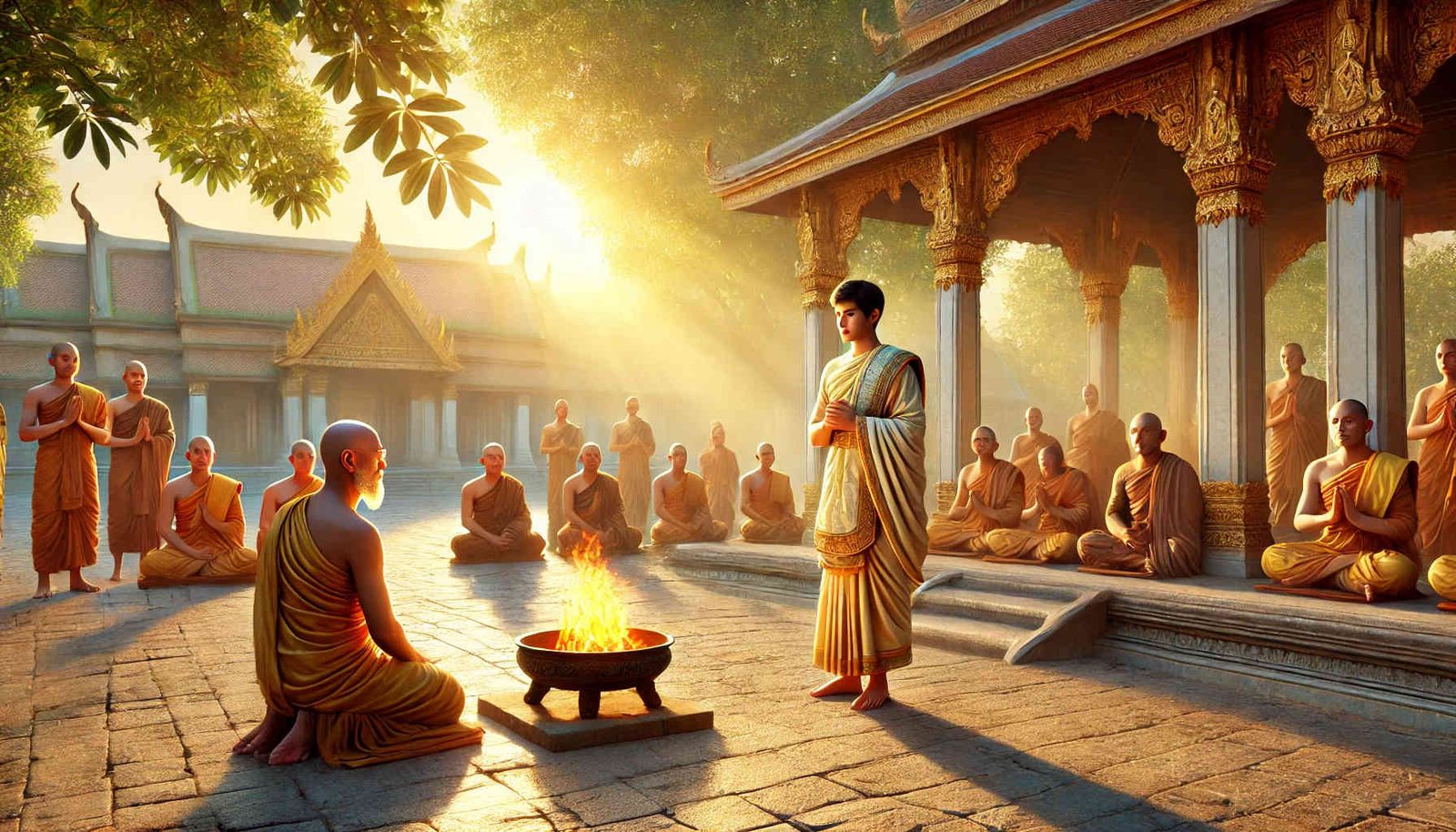
After the offering was completed, the upāsikā prepared a high seat and respectfully invited the elder to ascend and expound the Dharma. With utmost sincerity, she prostrated fully before the seat, bowing her head and requesting the teaching, not daring to raise her gaze.
Mahāla, who knew nothing, ascended the seat in fear and shame. Seeing the upāsikā kneeling so reverently before him, he could not help but sigh softly:
“I am ignorant and without knowledge—this is truly suffering.”
Hearing these words, the upāsikā regarded them as the most supreme treasure, as if entering meditative absorption. While she remained wholly focused, the old monk quietly fled and hastened back to the monastery.
The upāsikā then carefully contemplated the profound meaning of these two sentences:
“Ignorance is the root of the Twelvefold Dependent Origination. From this root of suffering, the cycle of birth and death continues without end, giving rise to all afflictions—therefore it is indeed great suffering.”
Reflecting thus again and again, she immediately realized the first of the four fruits—the stage of Srotaāpanna—entering the stream of the noble path.
Having attained realization, the upāsikā hurried to open her treasury and took out a precious robe as an offering of gratitude to her teacher. Yet the elder was nowhere to be found. She searched everywhere but could not find him, and thought to herself that perhaps he had returned to the monastery by supernatural powers.
Thus, she took the robe and went to the Pine Monastery to seek him. Meanwhile, the old monk, having returned, was filled with fear, thinking that the donor might come seeking him. He shut himself inside his quarters and refused to see anyone.
Mahāla’s teacher was an Arhat possessed of supernatural powers. Seeing the upāsikā arriving in haste, he suspected that Mahāla had committed some fault. Entering meditative concentration, he observed the situation and learned that the upāsikā had attained the fruit of Srotaāpanna. He then called Mahāla forth to receive the offering and explained to both of them that the karmic affinity they had formed in past lives had now matured.
Upon hearing his teacher’s instruction, Mahāla was freed from his fear and distress. Overcome with immeasurable joy, he too realized the fruit of Srotaāpanna.