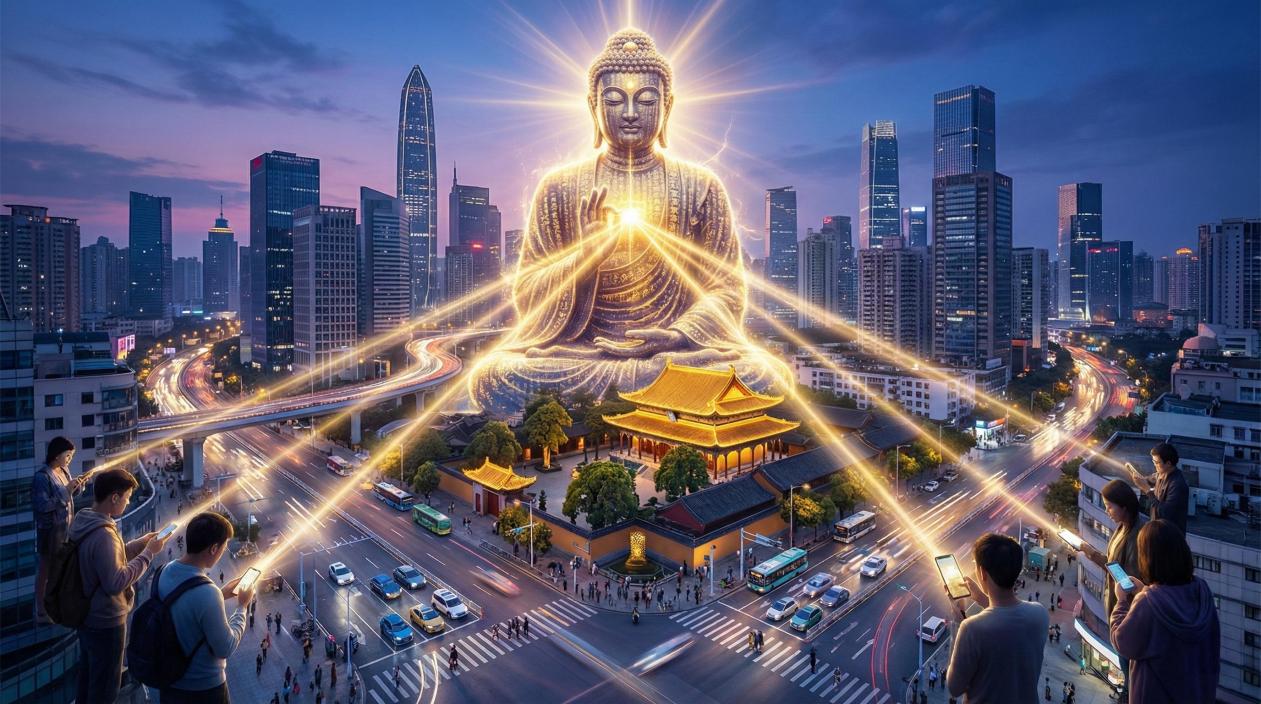
时间:02/17/2024 02/18/2024
地点:星河禅修中心
主讲:净诚
佛法知识
佛法与现代生活
“佛法与现代生活”这一命题,常被误解为传统思想如何适应当代节奏,或古老智慧如何缓解现代压力。事实上,这一问题的关键不在于“适应”,而在于澄清:佛法本身并不属于某个历史阶段,它所分析的对象——认知、行为、痛苦及其因果结构——在现代社会中不仅没有失效,反而更加显露其现实针对性。
现代生活的基本特征,可以概括为高复杂度、高速度与高度结构化。信息密集、角色分化、竞争机制与持续刺激,构成了当代社会的常态。这些条件并未改变生命的基本运行机制,但显著放大了无明与执取的后果。焦虑、失控感、意义缺失,并非新时代独有的问题,而是旧有心理机制在新环境下的加速表现。
佛法在此并不提供对抗现代性的价值判断,而是提供一套解析工具。佛法关注的核心,从来不是生活形态是否简朴或繁忙,而是认知是否清明。现代人所承受的压力,并不直接来源于工作、技术或社会系统,而来自对这些条件的错误理解与过度执取。佛法分析的重点,正是这种误解如何形成,又如何被解构。
在现代语境下,“无常”不再只是生老病死的哲学概念,而是每天都在经验中的事实:职业不稳定、关系流动、信息迅速过期、身份随情境而变。问题不在于无常是否存在,而在于是否仍试图以固定的自我、恒定的安全感来对抗它。佛法指出,痛苦产生于这种认知错位,而非无常本身。
同样,“无我”在现代生活中并非否定个体,而是对身份幻觉的校正。现代社会高度依赖角色标签、成就叙事与自我形象,这些工具在功能上有效,却极易被误认为真实自我。当评价、比较与焦虑不断强化这一误认时,心理压力自然累积。佛法并不要求抛弃角色,而是区分功能性身份与执取性认同。
在实践层面,佛法并不要求脱离社会结构。戒,并非禁欲主义,而是对行为后果的清醒评估;定,并非逃避现实,而是使心在高度刺激中保持稳定;慧,也不是抽象哲学,而是对经验结构的直接洞察。在现代生活中,这三者构成一种可操作的自我调节系统,而非宗教修行的象征仪式。
需要强调的是,佛法并不承担“改善生活质量”的功利目标。它不承诺效率提升、成功保证或情绪愉悦。佛法所改变的,是人如何理解成功、失败、得失与不确定性。当认知结构发生转变,生活内容未必减少复杂性,但痛苦不再被自动放大。
因此,佛法与现代生活之间不存在冲突关系,也不存在简单的互补关系。现代性揭示问题,佛法分析问题。现代生活提供条件,佛法揭示这些条件如何被误解、放大,并最终转化为苦。佛法并不是为现代人量身定制的解决方案,而是一套在任何时代都成立的理解框架。
结论并不浪漫:佛法不能替代社会制度,也不能修复结构性问题。它所能做的,仅是指出——在不可避免的复杂生活中,哪些痛苦来自现实条件,哪些痛苦源于认知错误。对后者的澄清,正是佛法在现代生活中仍然具有现实意义的原因。
Date: 02/17/2024 02/18/2024
Location: Star River Meditation Center
Teacher: Jason
Dharma Knowledge
The Dharma and Modern Life
The topic “The Dharma and modern life” is often framed as a question of how an ancient tradition can adapt to contemporary society or help alleviate modern stress. This framing is already misleading. The relevance of the Dharma does not depend on adaptation, because the objects of its analysis—cognition, behavior, suffering, and causality—are not bound to any historical period. What has changed in modern life is not the structure of suffering, but the conditions under which it is intensified.
Modern life is characterized by high complexity, accelerated pace, and dense systems of organization. Information overload, role fragmentation, competitive metrics, and continuous stimulation define everyday experience. These conditions do not create new psychological mechanisms; they amplify existing ones. Anxiety, loss of control, and a sense of meaninglessness are not uniquely modern problems, but familiar patterns operating at greater speed and scale.
The Dharma does not evaluate modernity in moral terms. It offers an analytic framework. Its concern is never whether life is simple or busy, traditional or technological, but whether perception is accurate. Much of what is experienced as modern stress does not arise directly from work, technology, or social systems, but from how these conditions are interpreted and grasped. The Dharma focuses precisely on how such misinterpretation arises and how it can cease.
In this context, impermanence is no longer an abstract reflection on aging and death. It is a constant lived reality: unstable careers, shifting relationships, rapidly obsolete information, and fluid identities. The problem is not impermanence itself, but the attempt to secure permanent identity and certainty within it. According to the Dharma, suffering arises from this cognitive mismatch, not from change as such.
Likewise, non-self in modern life does not negate individuality. It functions as a correction to identity fixation. Contemporary society relies heavily on labels, achievements, and self-narratives. These are effective tools, but they are easily mistaken for a fixed self. When evaluation, comparison, and self-image are taken as intrinsic identity, psychological strain accumulates. The Dharma does not abolish roles; it distinguishes functional identities from objects of attachment.
Practically speaking, the Dharma does not demand withdrawal from society. Ethical discipline is not asceticism, but awareness of behavioral consequences. Mental stability is not escapism, but the capacity to remain clear amid constant stimulation. Wisdom is not abstract philosophy, but direct insight into how experience is structured. In modern life, these form an operational system of self-regulation rather than a set of religious rituals.
It is crucial to note that the Dharma does not aim at improving life quality in a utilitarian sense. It offers no promise of greater efficiency, success, or emotional pleasure. What it transforms is the way success and failure, gain and loss, certainty and uncertainty are understood. When cognition changes, life may remain complex, but suffering is no longer automatically compounded.
There is therefore no inherent conflict between the Dharma and modern life, nor a simple complementarity. Modern conditions expose problems; the Dharma explains them. Modern life supplies the stimuli; the Dharma reveals how misperception turns those stimuli into suffering. The Dharma is not tailored for modern individuals; it is a framework that remains valid in any era.
The conclusion is unsentimental. The Dharma cannot replace social institutions or resolve structural injustices. What it can do is clarify which forms of suffering arise from external conditions and which arise from cognitive error. It is this clarification that gives the Dharma its continued relevance within modern life.