时间:03/01/2025 03/02/2025
地点:星河禅修中心
主讲:黄云全
佛法修行
病比丘的看护
有一次,佛陀与比丘们游化到摩揭陀国首都王舍城,住在城北郊外迦兰陀竹园的竹林精舍。
那时,王舍城中有一位比丘得了重病,严重到连大小便都无法起床,但却没有其它比丘来探视看护,任他在床上日夜怨叹:
「为何世尊独独不怜悯我啊?」
佛陀以天耳神通,听见了那位病比丘的怨叹与呼唤,就对比丘们说:
「我和你们一同到各处寮房走走,看看你们住的地方。」
佛陀借着这个理由,带着大家来到病比丘的寮房。病比丘挣扎着要起来迎接佛陀,但却起不来。
佛陀阻止他说:
「躺着就可以了!比丘!不要起来,我可以自己找位子坐。你的病好些了吗?」
「世尊!我的病越来越重了。」
「比丘!看护你的人在哪里呢?有人来探视你吗?」
「没有,世尊!自从我得病以来,都没人来探视我。」
「比丘!当你还没生病时,有没有常常探望其它病人呢?」
「没有,世尊!」
「比丘!平常你都不探望病人,所以今天才得不到别人的照顾。比丘!现在你不要害怕,我亲自来照顾你,让你不缺什么。虽然我的成就在今日天上人间中最高,但我也能照顾任何病人:对得不到救护的人施与救护;做盲者的眼目;救护生病的人们。」
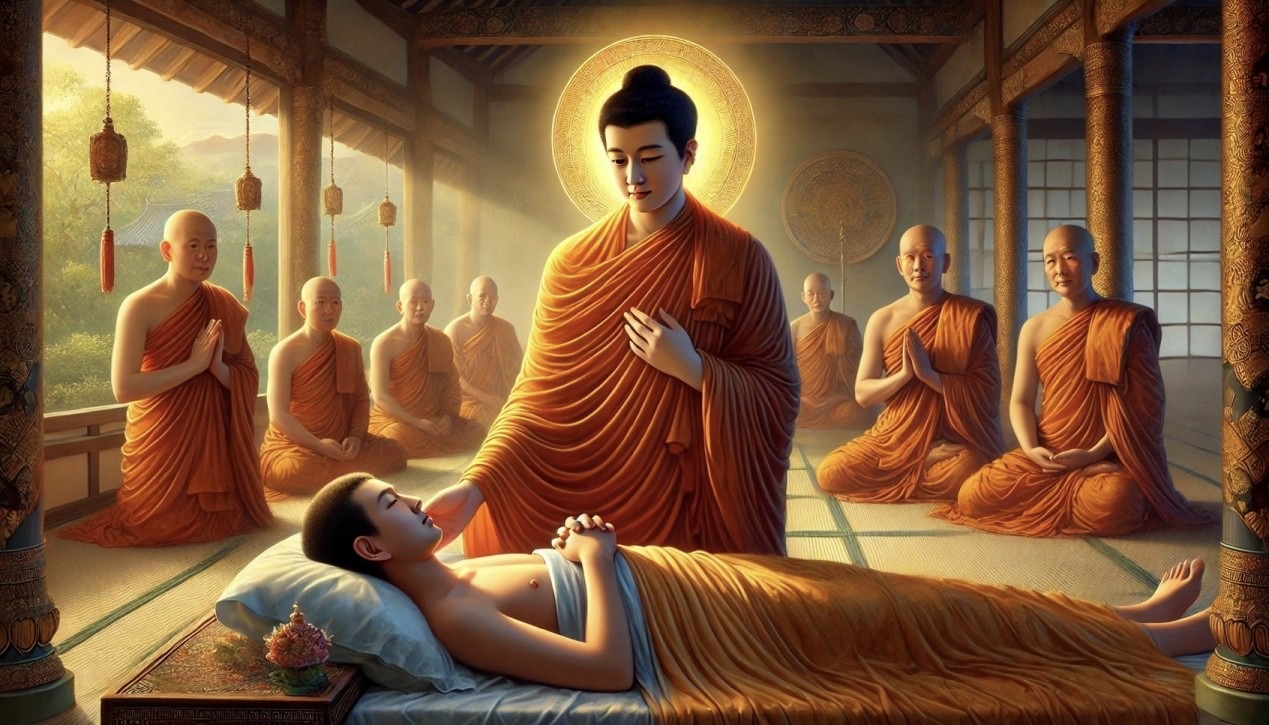
说完后,佛陀亲自为他清理排泄物,擦洗身体,换洗衣服床单,整理床铺,打扫房间,还亲手喂食。
做完这些,佛陀利用这个机会,教导这位比丘说:
「比丘!应当舍离三世轮回的大病,怎么说呢?出生时,有在胎中不自由的灾难,出生后,有老病死的苦迫。人一老,生理机能变差,病痛随之而来。生病的人,或躺或坐地呻吟,各种病症接踵而来,最后难逃死亡。死亡,识与形体崩离了,然后往生善趣或恶趣之中。罪恶多的,往生极苦的地狱,也有生为畜生的,被人驱使,受很多苦,也有生为寿命长达数劫之饿鬼的,咽喉食道细小如针,难以吞食,又常受到鞭打。福报好的,生在寿命长达数劫的天上,但也难免于恩爱别离之苦,欲望难以满足。只有修证贤圣之道的,才能离苦。
有九种离苦之人,所谓阿罗汉、向阿罗汉、阿那含、向阿那含、斯陀含、向斯陀含、须陀洹、向须陀洹、种性人,这些都是如来的弟子。所以说,如来的出现,真是难逢;能出生为人,而且生于能听闻佛法之处;能遇见善知识;能听闻佛法,更是难得的机会。你应当了解:现在如来在世间宣说正法,你又没有生理上的缺陷能听闻正法,如果不努力修学,失去这样的机会,后悔就来不及了,这是我的教诫。」
这位病比丘经过了这番教诲,即证得解脱,病也好多了。
佛陀回去后,要尊者阿难集合在王舍城附近的比丘,当众制订了僧团成员生病时的看护制度:如果生病比丘没有弟子,则应当由大家轮流排班看护。
Date: 03/01/2025 03/02/2025
Location: Star River Meditation Center
Teacher: Yunquan Huang
Dharma Talk
The Care of the Sick Bhikkhu
Once, the Buddha, along with his bhikkhus, was traveling and arrived at Rājagaha, the capital of Magadha. They stayed in the Bamboo Grove Monastery at Kalandaka Bamboo Park, located in the northern outskirts of the city.
At that time, there was a bhikkhu in Rājagaha who had fallen seriously ill. His condition was so severe that he could not even get up to relieve himself. However, no other bhikkhus came to visit or care for him, leaving him to lie in bed day and night, lamenting:
”Why does the Blessed One alone show no compassion for me?”
Through his divine ear, the Buddha heard the sick bhikkhu’s lament and call. He then said to the bhikkhus:
”Let us go together and visit the residences of the bhikkhus to see where you all live.”
Using this as a reason, the Buddha led the bhikkhus to the dwelling of the sick bhikkhu. The sick bhikkhu struggled to get up to greet the Buddha but was unable to rise.
The Buddha stopped him and said:
”Just lie down, bhikkhu! Do not get up; I can find a seat myself. Has your condition improved?”
”Blessed One! My illness is getting worse.”
”Bhikkhu! Where is the person caring for you? Has anyone come to visit you?”
”No, Blessed One! Since I fell ill, no one has come to see me.”
”Bhikkhu! Before you became ill, did you often visit and care for other sick bhikkhus?”
”No, Blessed One!”
”Bhikkhu! Because you never visited or cared for others when they were sick, now you too receive no care from others. Bhikkhu! Do not be afraid now. I will personally care for you and ensure you lack nothing. Even though my achievements today are the highest among both devas and humans, I can still care for any sick person: I offer help to those without aid, become the eyes for the blind, and provide care to the ill.”
After saying this, the Buddha personally cleaned the sick bhikkhu’s excrement, washed his body, changed his clothes and bedding, tidied the bed, cleaned the room, and even fed him by hand.
After finishing these tasks, the Buddha used this opportunity to instruct the bhikkhu:
”Bhikkhu! You should abandon the great illness of the threefold cycle of rebirth. Why is this so? At birth, there is the suffering of being confined in the womb. After birth, one experiences the afflictions of aging, illness, and death. When a person ages, their bodily functions deteriorate, and illnesses follow. A sick person groans whether lying down or sitting, suffering from various ailments until they ultimately cannot escape death. At death, the mind separates from the body, leading to rebirth in either a good or bad realm. Those who have committed many evil deeds are reborn into extreme suffering in the hell realms. Some are reborn as animals, subjected to human control and hardship. Others are reborn as hungry ghosts with lifespans lasting many kalpas, suffering from throats as thin as needles, making it difficult to swallow food, and often enduring beatings. Those with good karma are reborn in heavenly realms with lifespans lasting many kalpas, yet even they cannot escape the pain of separation from loved ones or the insatiability of desires. Only those who cultivate the path of the noble ones can be free from suffering.
There are nine kinds of people who attain liberation: the Arahant, the one progressing toward Arahantship, the Anāgāmin, the one progressing toward Anāgāminship, the Sakadāgāmin, the one progressing toward Sakadāgāminship, the Sotāpanna, the one progressing toward Sotāpannaship, and the one with the seed of enlightenment. These are all disciples of the Tathāgata. Therefore, the appearance of a Tathāgata in this world is truly rare. Being born as a human and having the opportunity to hear the Buddha’s teachings is even rarer. Meeting a good teacher and hearing the Dharma is an extremely fortunate opportunity. You must understand that the Tathāgata is now in the world, expounding the true Dharma. You have no physical impairments preventing you from hearing the teachings. If you do not strive to cultivate and lose this opportunity, regret will come too late. This is my instruction to you.”
After receiving this teaching, the sick bhikkhu attained liberation, and his illness significantly improved.
returning, the Buddha instructed Venerable Ānanda to gather the bhikkhus near Rājagaha. He then established a regulation for the Saṅgha: if a sick bhikkhu has no disciples to care for him, the other bhikkhus must take turns providing care.