时间:05/10/2025 05/11/2025
地点:星河禅修中心
主讲:黄云全
佛法修行
谁先见佛陀
有一次,佛陀住在憍萨罗国首都舍卫城南郊的祇树给孤独园。
一天,三十三天的统领释提桓因来见佛陀,劝请佛陀到三十三天为佛陀的母亲说法,得到佛陀的默许。
隔了几天,佛陀心想:人间的比丘、比丘尼,优婆塞、优婆夷等四众弟子,有许多是懈怠不十分乐意听法的,他们不努力使自己证果,也不努力求进步,我应当离开他们一阵子,以重新激起他们对法的渴望。于是,佛陀离开给孤独园,以神通力来到三十三天。
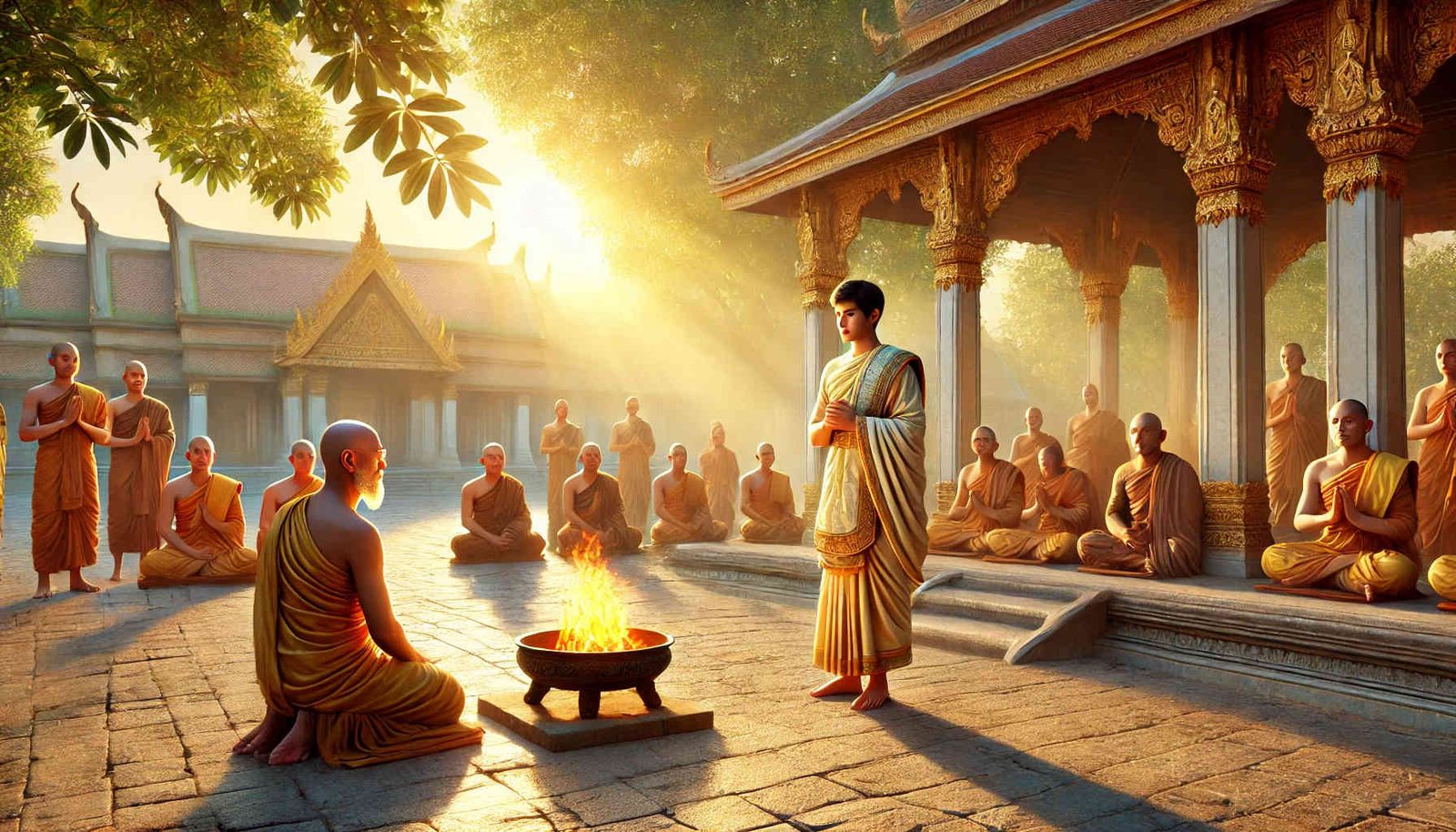
释提桓因看见佛陀来了,领着天众们迎接佛陀,向佛陀顶礼请安。
这时,佛陀又展现神通力,将自己的身体变大到一由旬,并隐其形,让人类即使以天眼神通也看不到他。
佛陀坐在石座上,母亲摩耶领着许多天女们来礼见佛陀,释提桓因与许多三十三天的天众,也都来礼见佛陀,围坐在佛陀的四周,准备听闻佛陀说法。佛陀的说法,先让他们生起欢喜心,接着说布施、持戒等人天善行,再说欲贪是大祸患,是不清净的,应当舍离。待他们能接受这些道理,有了听闻佛法的基础后,便开始宣讲苦、集、灭、道等佛法核心的四圣谛。说完四圣谛后,在座的天众们,有许多即证得了初果。
说法完毕后,释提桓因问佛陀说:
「世尊!我应当以什么类的食物供养如来呢?用人间的食物呢?还是天界的食物?」
「释提桓因!用人间的食物。为什么呢?因为我生于人间,长于人间,在人间成佛。」
「是的,世尊!又,吃饭的时间,是以天上的为准呢?还是以人间的为准?」
「释提桓因!以人间的时间为准。」
「好的,世尊!」
这样一来,释提桓因就以人间的食物,人间的时间供养佛陀。三十三天的天众们,因此老是看见佛陀在进食,而议论纷纷。
佛陀知道了,只好再展神通,在想见诸天时,才让诸天众来,要诸天离开时,他们就离开。释提桓因也向诸天解释,佛陀是依人间的时间进食,而不依三十三天的时间。
就这样,人间的四众弟子们,有好一段时日见不到佛陀,因而开始想念佛陀,纷纷向尊者阿难探询。
尊者阿难也不知道佛陀到哪里去了。
即使天眼第一的尊者阿那律,观遍了各个世界,也看不见佛陀在哪里。
尊者阿难还一度怀疑,佛陀会不会入涅槃了呢?
就这样过了三个月,直到有一天,一位三十三天的天子告诉尊者阿那律,大家才知道,原来佛陀在三十三天为母亲说法。于是,大家公推神足神通第一的尊者目犍连,到三十三天请求佛陀返回人间。
尊者目犍连到了三十三天,看见佛陀被众多天子围绕,心想:佛陀在这里一定不得安宁。
佛陀告诉他说:
「目犍连!你刚刚心想:如来在这里一定不得安宁,是吗?其实不会的。我每次说法,都不会占太多时间,而且只有我想见诸天时,诸天众才来,不想见他们时,他们就不会来。你先回去,七天后,如来会在僧迦尸国的大池边回人间。」
佛陀即将回人间的消息,传遍了各国,大家都很兴奋,各国国王也争相前往迎接。
这时,尊者优铃华色比丘尼心想:大家都想去迎接佛陀,到时候人一定很多,我就这样前往,一定很难见到佛陀,不如化作转轮圣王的模样比较有利。于是,尊者优铃华色比丘尼,以她的神通力,化成极为庄严大威势的圣王模样。
同一时间里,尊者须菩提在王舍城北郊灵鹫山的一个山洞里缝衣服,也想去迎接佛陀。但当他放下手上的衣服,站起来跨出右脚,脚一落地时想到:
「我要迎接世尊,但哪一部分才是世尊?眼、耳、鼻、舌、身、意吗?地、水、火、风的哪一种呢?一切诸法都是空寂的,正如世尊所说的:
要礼见最崇高的佛,就从蕴处界中观得无常;
不论过去未来现在,诸佛都宣说这无常之理。
想见任何一世的佛,都应当观这样的空寂法;
想见任何一世的佛,都应当在无我上下功夫。
之中所说的无我,就是诸法皆悉空寂。有什么我呢?这个五蕴之身,是找不到做得了主的部分的。现在,让我归依真实正法处。」
想到这里,尊者须菩提就又坐下来继续缝衣了。
另一方面,尊者优铃华色比丘尼所化现的转轮圣王,受到各国国王与群众的赞叹与礼让,在佛陀起脚踏回大地时,第一位到达佛陀的面前。
这时,尊者优铃华色比丘尼恢复成原来模样,各国国王看见了,不免怨叹让一位比丘尼捷足先登了。
尊者优铃华色比丘尼向佛陀顶礼,对佛陀说:
「现在我礼见最崇高的世尊,今天最先见到世尊的,是我优铃华色比丘尼,如来的弟子。」
佛陀回答他说:
「须菩提是最先礼见如来的,没有人比他更早了。能观空、无我的解脱法门,这是礼佛的实质意义。即使想要礼见未来或过去的诸佛,也应当从观空、无我来完成,这是礼佛的实质意义。」
Date: 05/10/2025 05/11/2025
Location: Star River Meditation Center
Teacher: Yunquan Huang
Dharma Talk
Who Saw the Buddha First
Once, the Buddha was staying at the Jeta Grove, Anathapindika’s Park, located in the southern suburbs of Shravasti, the capital of the Kosala kingdom.
One day, Śakra, the Lord of the Heaven of the Thirty-Three, came to see the Buddha and invited him to come to the Heaven of the Thirty-Three to preach the Dharma to the Buddha’s mother. The Buddha silently agreed.
A few days later, the Buddha thought: the bhikkhus and bhikkhunis, upāsakas and upāsikās among the fourfold assembly of human disciples are many who are lazy and not very willing to listen to the Dharma. They do not make efforts to attain realization nor strive for progress. I should leave them for a while, so that they may rekindle their longing for the Dharma.
Thus, the Buddha left Anathapindika’s Park and, by means of his supernatural powers, arrived at the Heaven of the Thirty-Three.
When Śakra saw the Buddha arrive, he led the heavenly beings to welcome the Buddha, paying homage and asking after his well-being.
At that moment, the Buddha again displayed his supernatural power, enlarging his body to one yojana in height, and hiding his form so that even beings with divine vision could not see him.
The Buddha sat upon a stone seat. His mother, Māyā, led many celestial maidens to pay homage to him. Śakra and many deities from the Heaven of the Thirty-Three also came to pay respects, and they all sat in a circle around the Buddha, ready to listen to his preaching.
The Buddha’s discourse first aroused joy in them. Then he spoke of giving, keeping precepts, and other wholesome deeds for humans and gods. Next, he said that sensual craving is a great danger, impure and to be abandoned.
Once they could accept these teachings and had a foundation of hearing the Dharma, he began to explain the core of the Buddha’s teachings—the Four Noble Truths: suffering, the origin of suffering, the cessation of suffering, and the path.
After he finished explaining the Four Noble Truths, many of the deities present attained the first fruit of the path (sotāpanna).
When the sermon was over, Śakra asked the Buddha:
“World-Honored One! With what kind of food should I make offerings to the Tathāgata? Should I use human food or heavenly food?”
“Śakra! Use human food. Why? Because I was born in the human world, grew up in the human world, and attained Buddhahood in the human world.”
“Yes, World-Honored One! Also, when it comes to mealtime, should I follow heavenly time or human time?”
“Śakra! Follow human time.”
“Very well, World-Honored One!”
Thus, Śakra offered the Buddha human food at human time. Because of this, the deities in the Heaven of the Thirty-Three constantly saw the Buddha eating and started talking about it.
The Buddha became aware of this, and once again displayed his supernatural power: he would allow the deities to see him only when he wished to see them. When he did not wish to see them, they would disappear. Śakra also explained to the other gods that the Buddha ate according to human time, not heavenly time.
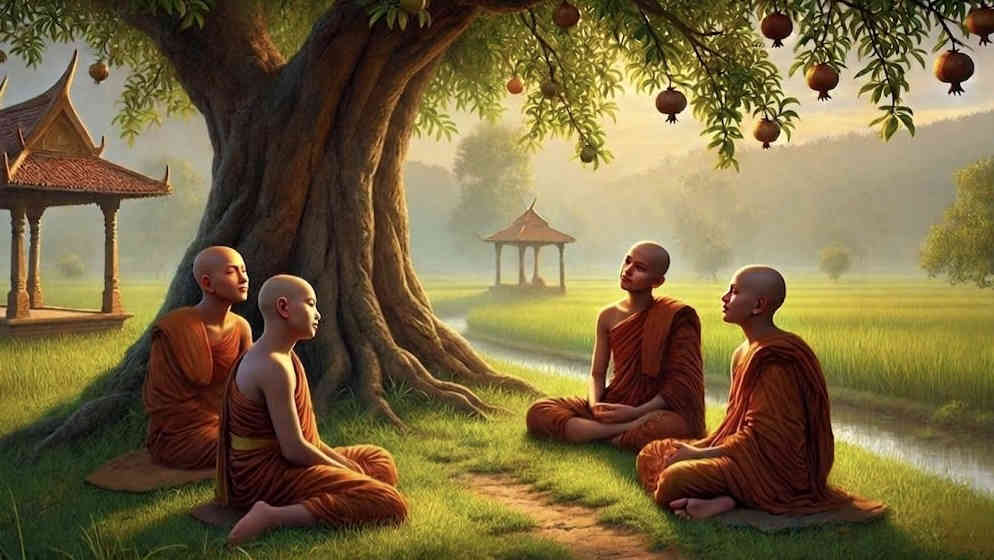
In this way, the fourfold assembly in the human world went a long time without seeing the Buddha, and they began to miss him. They all inquired with Venerable Ānanda.
But Venerable Ānanda also did not know where the Buddha had gone.
Even Venerable Aniruddha, foremost in the divine eye, searched all the worlds but could not see where the Buddha was.
Venerable Ānanda even began to wonder: Could it be that the Buddha has entered Nirvāṇa?
Three months passed like this, until one day a deity from the Heaven of the Thirty-Three told Venerable Aniruddha. Only then did everyone know that the Buddha was in the Heaven of the Thirty-Three preaching the Dharma to his mother.
So, everyone unanimously agreed to send Venerable Mahāmaudgalyāyana, who was foremost in supernatural powers, to the Heaven of the Thirty-Three to request the Buddha’s return to the human world.
When Venerable Mahāmaudgalyāyana arrived in the Heaven of the Thirty-Three, he saw the Buddha surrounded by countless gods. He thought: The Buddha surely must not be at ease here.
The Buddha said to him:
“Mahāmaudgalyāyana! Just now you thought: ‘The Tathāgata must not be at ease here,’ is that right? In fact, it is not so. Every time I preach, it does not take much time. And the deities only come when I wish to see them. When I do not wish to see them, they do not come. You may go back first. Seven days from now, the Tathāgata will return to the human world beside the great pond in the country of Saṅkāśya.”
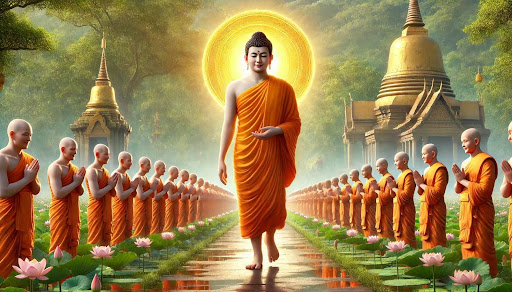
The news that the Buddha was about to return to the human world spread through all the kingdoms. Everyone was excited, and the kings of various countries all competed to go welcome him.
At this time, Venerable Utpalavarṇā Bhikkhunī thought: Everyone wants to welcome the Buddha. When the time comes, there will definitely be a large crowd. If I just go like this, it will be very hard to see the Buddha. It would be better to transform into the appearance of a Wheel-Turning Sage King.
So, Venerable Utpalavarṇā Bhikkhunī used her supernatural power and transformed into the majestic form of a noble, awe-inspiring sovereign.
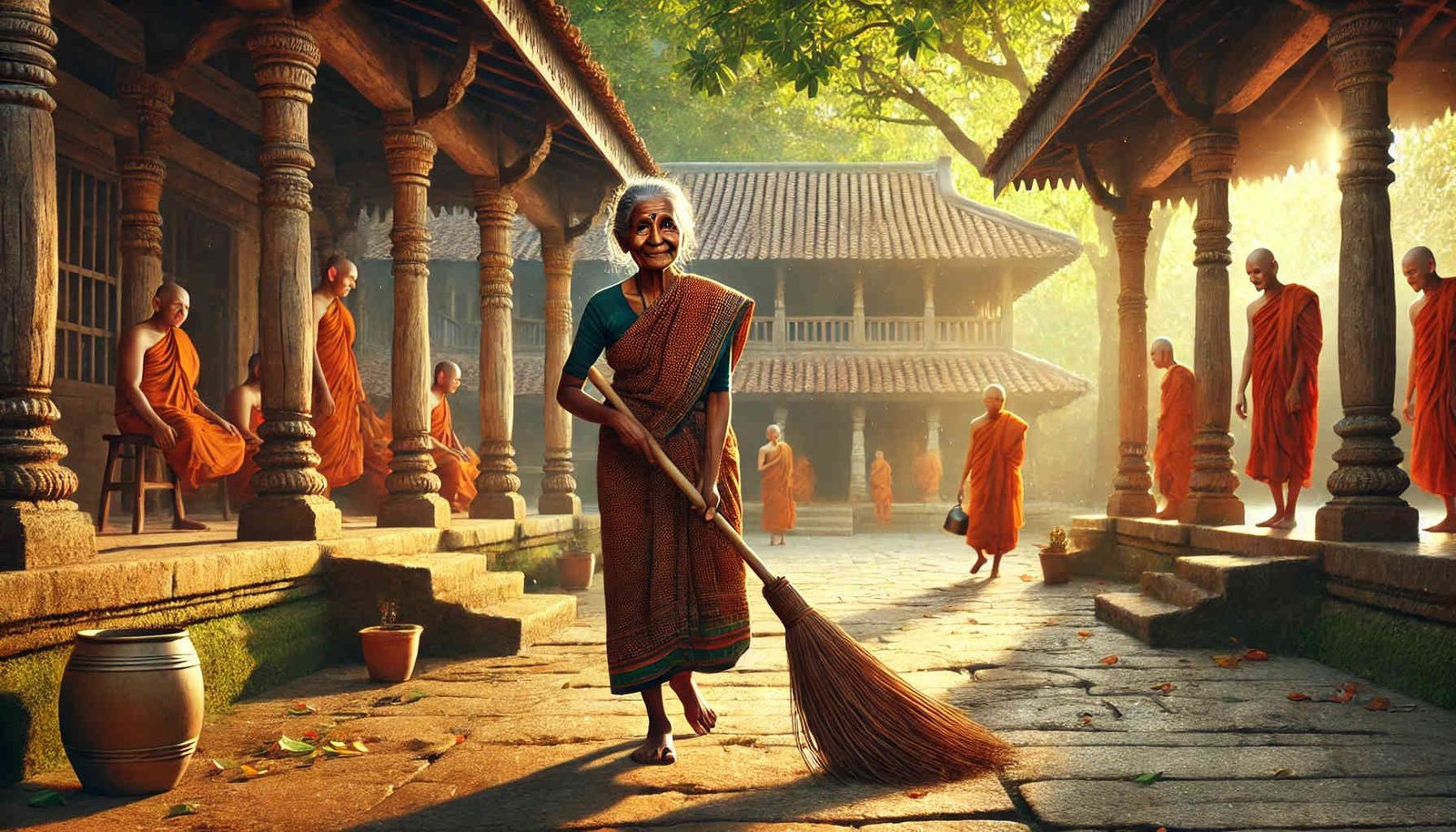
At the same time, Venerable Subhūti was sewing robes in a cave on Vulture Peak in the northern suburbs of Rājagaha. He also wanted to go welcome the Buddha. But as he put down his robe and stepped out with his right foot, he thought:
“I want to welcome the World-Honored One. But which part is the World-Honored One? The eye, ear, nose, tongue, body, or mind? Which of the elements—earth, water, fire, or wind? All dharmas are empty and still, just as the World-Honored One has said:
To pay homage to the most exalted Buddha, observe impermanence within the aggregates,Past, future, and present Buddhas all proclaim the truth of impermanence.
To see any Buddha of any time, one should contemplate this truth of emptiness and stillness.
To see any Buddha of any time, one should practice on the basis of non-self.
This non-self spoken of here means that all dharmas are empty and still—Where then is the ‘self’?
This five-aggregate body has no master within.
Now, let me take refuge in the place of true and proper Dharma.”
Thinking this, Venerable Subhūti sat back down and continued sewing robes.
On the other hand, the transformed Wheel-Turning King by Venerable Utpalavarṇā Bhikkhunī was praised and honored by all the kings and people of the lands.
When the Buddha set foot back on the earth, she was the first to arrive before him.
At that moment, Venerable Utpalavarṇā Bhikkhunī returned to her original form. When the kings saw her, they could not help but complain that a bhikkhunī had gotten ahead of them.
Venerable Utpalavarṇā Bhikkhunī bowed to the Buddha and said:
“Now I bow to the most exalted World-Honored One. Today, the first person to see the World-Honored One was me—Bhikkhunī Utpalavarṇā, a disciple of the Tathāgata.”The Buddha replied:
“Subhūti was the first to pay homage to the Tathāgata. No one was earlier than he.
One who contemplates the Dharma of emptiness and non-self—this is the true meaning of paying homage to the Buddha.
Even if one wishes to pay homage to Buddhas of the future or the past, one must do so by contemplating emptiness and non-self. This is the true meaning of paying homage to the Buddha.”