时间:05/03/2025 05/04/2025
地点:星河禅修中心
主讲:黄云全
佛法修行
弗区沙提的奇遇
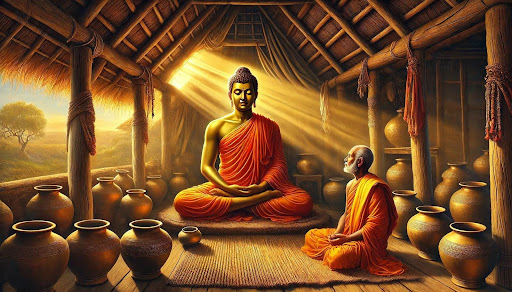
有一次,佛陀到摩揭陀国首都王舍城游化,向一位名叫「拔伽瓦」的陶器制作师傅要求借住一晚。
陶匠拔伽瓦说:
「世尊!我无所谓,但陶屋里已经有一位出家人先来借住了,如果他没意见,那就随您住了。」
那位先在陶器制作屋借住的出家人,正是仰慕佛陀而自行出家,穿着比丘服的尊者弗区沙提。
佛陀进屋后,对已经在屋子里的尊者弗区沙提说:
「比丘!我想在这里借住一晚,你同意吗?」
「道友!我无所谓。这屋子很宽敞,你就随意选个地方睡吧!」
于是,佛陀那晚就在陶器制作屋内,与尊者弗区沙提一同住下。
当晚,尊者弗区沙提跟着佛陀禅坐到很晚。他这样好的耐力,引起了佛陀的关注,就问他说:
「比丘!你的老师是谁?你是跟谁出家修学的?」
「道友!释迦族的沙门瞿昙是我的老师,我就是跟他出家修学的。」
「比丘!你见过他吗?」
「没有!」
「如果遇见他,你认得吗?」
「不认得,但世尊是值得供养者、圆满的觉悟者、真理与正行的实践者、完善幸福的终结生死者、彻底了知世间者、受调教人的无上领导者、天界人间的老师、觉他的自觉者、世间最尊贵者,因为我很仰慕他才出家,所以,世尊是我的老师。」
佛陀心想:
「这位善男子因仰慕我而出家,我应当教导他。」
于是,佛陀对尊者弗区沙提说:
「比丘!让我为你解说六界,这对你的清净的修行很有帮助,请你仔细听,好好思惟。」
「好的,道友!」
佛陀详细说明了身体中的地、水、火、风、空。接着,讲解什么是不放逸慧、最上正慧、最上真谛、最上舍离、最上止息:
「比丘!对地、水、火、风、空,应当以正慧如其事实地看:这一切都不是我的,也不成我慢,亦不是真我。能够这样,心就不会有所执着而能离欲,这就称为不放逸慧。
除了地、水、火、风、空之外,还有识。识可以认知什么呢?识可以认知苦、乐、不苦不乐。这是经由感官认识境界后所生起的触,感受到或苦、或乐、或不苦不乐而生起苦受、乐受、不苦不乐受。当感受苦、乐、不苦不乐的触止息了,所生起的苦受、乐受、不苦不乐受,也就跟着消失了。这就好比两块木片相互摩擦会生热,但如果将这两块木片分开,其热度就会消散而变冷了一样。
比丘如果对苦受、乐受、不苦不乐受等三类感受不起染着,那么,就只剩下极清净的舍了。比丘以此清净的舍,进入无量空处、无量识处、无所有处、非想非非想处,就像金饰匠,将金块锻成又柔软又有光泽的薄片,然后就可以拿来加工,制成各种美丽的金饰一样。
如果比丘能进一步体认,所进入的无量空处、无量识处、无所有处、非想非非想处,都还是有为、无常、苦的而不执着,因不执着而得解脱,这就好比油灯,因有油、有灯芯而灯火得以维持,如果不继续添油,灯芯也不加整理,那么油烧完了,灯火就熄灭了一样。
这样,解脱的比丘因断尽了所有的苦迫,就具足了最上的正慧;因稳固地安住于真谛不移动,就具足了最上的真谛;因从根本处舍离了过去所有的拥有,就具足了最上的舍离;因从根本处止息了所有的贪瞋痴,就具足了最上的止息。
比丘!『我』之执见只是妄想;『我是这个』、『我应当是这样』、『我应当不是这样』、『我应当是有色的』、『我应当是无色的』、『我应当是有想的』、『我应当是无想的』、『我应当是非想非非想的』,这些执见全都是妄想。能克服所有妄想的人,就是不生、不老、不死、不动摇、不恐怖的寂静圣者。」
听了佛陀这番教导,尊者弗区沙提即刻远尘离垢,得证法眼清净的初果。他心想:眼前这位一定是我仰慕已久的老师,一定是世尊了。于是,赶紧从座位上起来,向佛陀顶礼,并对刚才直呼佛陀为道友的冒犯,表示了真诚的忏悔,并期望能在佛陀处受具足戒。
由于尊者弗区沙提还没准备妥受具足戒应有的衣与铃,所以佛陀要他再去准备。结果,衣与铃还没备妥,却被狂奔的母牛抵死了。
佛陀记说他死时,已断了五下分结。
Date: 05/03/2025 05/04/2025
Location: Star River Meditation Center
Teacher: Yunquan Huang
Dharma Talk
The Strange Encounter of Vakkali
Once, the Buddha was traveling in Rajagaha, the capital of the kingdom of Magadha, and asked a potter named Bhaggava if he could stay overnight.
The potter Bhaggava said:
”World-Honored One! I don’t mind, but there’s already a monk who came earlier and is staying in the pottery hut. If he has no objection, then you may stay.”
The monk who had arrived earlier and was staying in the pottery hut was none other than the venerable Vakkali, who had renounced the world and become a monk because he admired the Buddha, and was now wearing the robe of a bhikkhu.
After the Buddha entered the hut, he said to Vakkali, who was already inside:
”Bhikkhu! I would like to stay here for one night, do you agree?”
”Friend! I don’t mind. This hut is spacious. Just pick any place to sleep as you wish.”
So that night, the Buddha stayed in the pottery hut together with the Venerable Vakkali.
That evening, Venerable Vakkali meditated together with the Buddha until very late. His endurance was impressive and drew the Buddha’s attention, who then asked:
”Bhikkhu! Who is your teacher? With whom did you renounce and practice?”
”Friend! The ascetic Gotama of the Shakya clan is my teacher. I renounced and practiced under him.”
”Bhikkhu! Have you seen him before?”
”No!”
”If you met him, would you recognize him?”
”No, I wouldn’t. But the World-Honored One is the Worthy One, the Perfectly Enlightened One, the Practitioner of Truth and Righteousness, the Completer of Happiness and Ender of Birth and Death, the Thorough Knower of the World, the Supreme Leader of those to be trained, the Teacher of gods and humans, the Self-Awakened One who awakens others, the Most Noble in the World. Because I greatly admire him, I renounced the world. So, the World-Honored One is my teacher.”
The Buddha thought:
”This good man renounced because of his admiration for me. I should teach him.”
So the Buddha said to Venerable Vakkali:
”Bhikkhu! Let me explain to you the six elements. This will be helpful to your pure practice. Please listen carefully and contemplate well.”
”Okay, friend!”
The Buddha then explained in detail the earth, water, fire, air, and space elements in the body. Then he explained the nature of non-negligent wisdom, supreme wisdom, supreme truth, supreme renunciation, and supreme cessation:
”Bhikkhu! Regarding earth, water, fire, air, and space, you should see them with right wisdom as they truly are: none of these is mine, nor should they give rise to pride or be taken as self. If one can see them this way, the mind will not cling, and will be free from desires. This is called non-negligent wisdom.
Besides earth, water, fire, air, and space, there is consciousness. What can consciousness know? Consciousness can know suffering, pleasure, and neither-suffering-nor-pleasure. These arise from contact following sensory experience, which leads to feelings of either suffering, pleasure, or neither. When such contact ceases, the resulting feelings of suffering, pleasure, or neutrality also disappear. It’s like two sticks rubbing together to produce heat—once the sticks are separated, the heat dissipates and cools down.
If a bhikkhu is not attached to the three types of feeling—suffering, pleasure, and neutrality—then only pure equanimity remains. With this pure equanimity, the bhikkhu can enter the realm of infinite space, the realm of infinite consciousness, the realm of nothingness, and the realm of neither-perception-nor-non-perception—just like a goldsmith hammers gold into a soft and shiny sheet, which can then be crafted into various beautiful ornaments.
If the bhikkhu further realizes that even these states—realm of infinite space, infinite consciousness, nothingness, and neither-perception-nor-non-perception—are conditioned, impermanent, and unsatisfactory, and thus does not cling to them, then through non-attachment, he attains liberation. It’s like an oil lamp: as long as there is oil and a wick, the flame continues. But if no more oil is added and the wick is not maintained, the flame goes out once the oil is exhausted.
In this way, a liberated bhikkhu, having eradicated all suffering and affliction, is endowed with supreme wisdom; by abiding firmly in unshakable truth, he is endowed with supreme truth; by letting go from the root all possessions of the past, he is endowed with supreme renunciation; by extinguishing at the root all greed, hatred, and delusion, he is endowed with supreme cessation.
Bhikkhu! The view of ‘I’ is just delusion: ‘I am this’, ‘I should be like this’, ‘I should not be like this’, ‘I should be corporeal’, ‘I should be incorporeal’, ‘I should be perceptive’, ‘I should be non-perceptive’, ‘I should be neither-perceptive-nor-non-perceptive’—all these views are delusions. One who can overcome all delusions is a silent sage, unborn, unaging, undying, unmoving, and fearless.”
After hearing the Buddha’s teaching, Venerable Vakkali immediately removed dust and defilement from his mind and attained the pure Dharma eye—entry into the first stage of enlightenment. He thought: “This person before me must be the teacher I have long admired—it must be the World-Honored One.”
So he quickly rose from his seat, bowed to the Buddha, sincerely repented for having just addressed the Buddha as “friend”, and hoped to receive full ordination from the Buddha.
Since Venerable Vakkali had not yet prepared the robes and alms bowl required for full ordination, the Buddha told him to go prepare them. But before he could finish, he was gored to death by a charging cow.
The Buddha later said that at the time of his death, he had already severed the five lower fetters.